
A community for every stage.
The environment serves children from 8 months to 6 years. Each stage of development has its own prepared room, its own apparatus, its own daily rhythm and its own mentor, and each is a community in which the child is a working member rather than a pupil.
The Full Learning Journey
At The Ardee Schools, education is conceived as a continuous and carefully considered journey, from Montessori foundations through to Cambridge.
Each Key Stage builds upon the last, combining the National Curriculum of England with Cambridge International Education to provide both breadth and depth of learning.
Our approach places equal emphasis on intellectual rigour and personal development. Students are encouraged to think independently, engage with curiosity, and develop a global outlook, preparing them not only for examinations, but for life beyond the classroom.
One method, several communities.
Dr. Montessori observed that the first six years of life form a single plane of development with distinct phases within it: the infant who absorbs unconsciously, the toddler who insists on doing it alone, the child of three who begins to work with intention, and the child of five whose intelligence has become conscious and social. The Houses are organised around these phases. NIDO, Red, Blue and the Early Years Foundation Stage (EYFS) are the environments at Noida.
Every environment shares the same essentials: authentic Montessori apparatus, a prepared room scaled to the child, a certified Montessori mentor, and a daily rhythm long enough for real concentration.
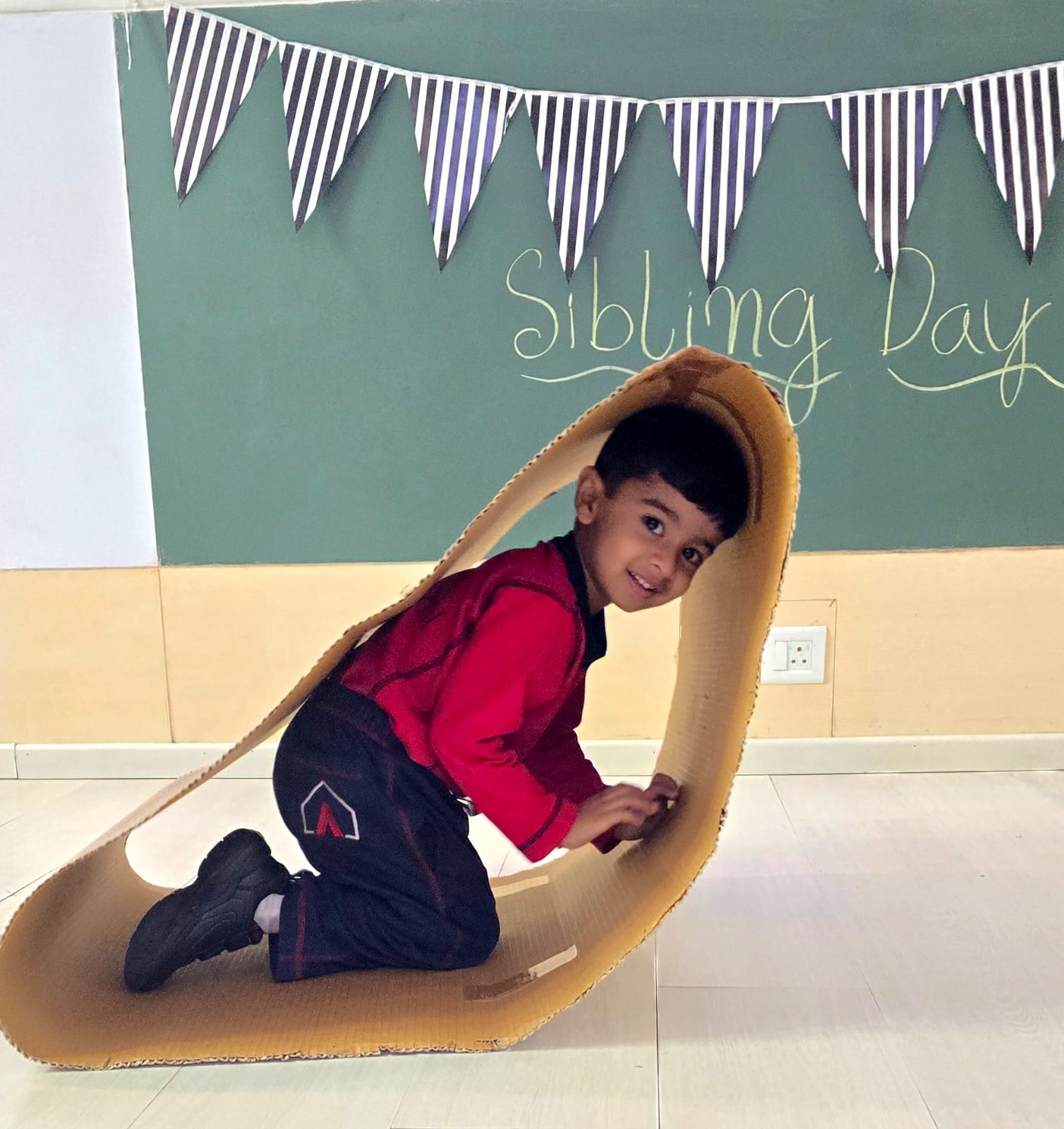
NIDO · the infant and toddler community
Nido is the Italian word for nest. The NIDO environment provides an age-appropriate Montessori experience for the youngest children of the House, in a calm and orderly room that becomes their own, under the care of their mentor and their parent. The environment is attended together by child and parent, so that the first steps into a community are taken from the security of a familiar hand.
The materials of NIDO answer the sensitivities of this age: movement, language and order. A Montessori mobility zone lets a child pull up, cruise and walk safely; low shelves hold a small number of purposeful materials; everything is real, beautiful and returned to its place. [CONFIRM: NIDO entry age. The prospectus states the environment serves children from 8 months; the group site states 10 months; the Gurugram brochure states 18 months; the earlier Noida site described NIDO as 18 to 24 months] [CONFIRM: NIDO session format and frequency; the earlier Noida site described three sessions a week of ninety minutes each, in a group of no more than twelve children with one mentor]
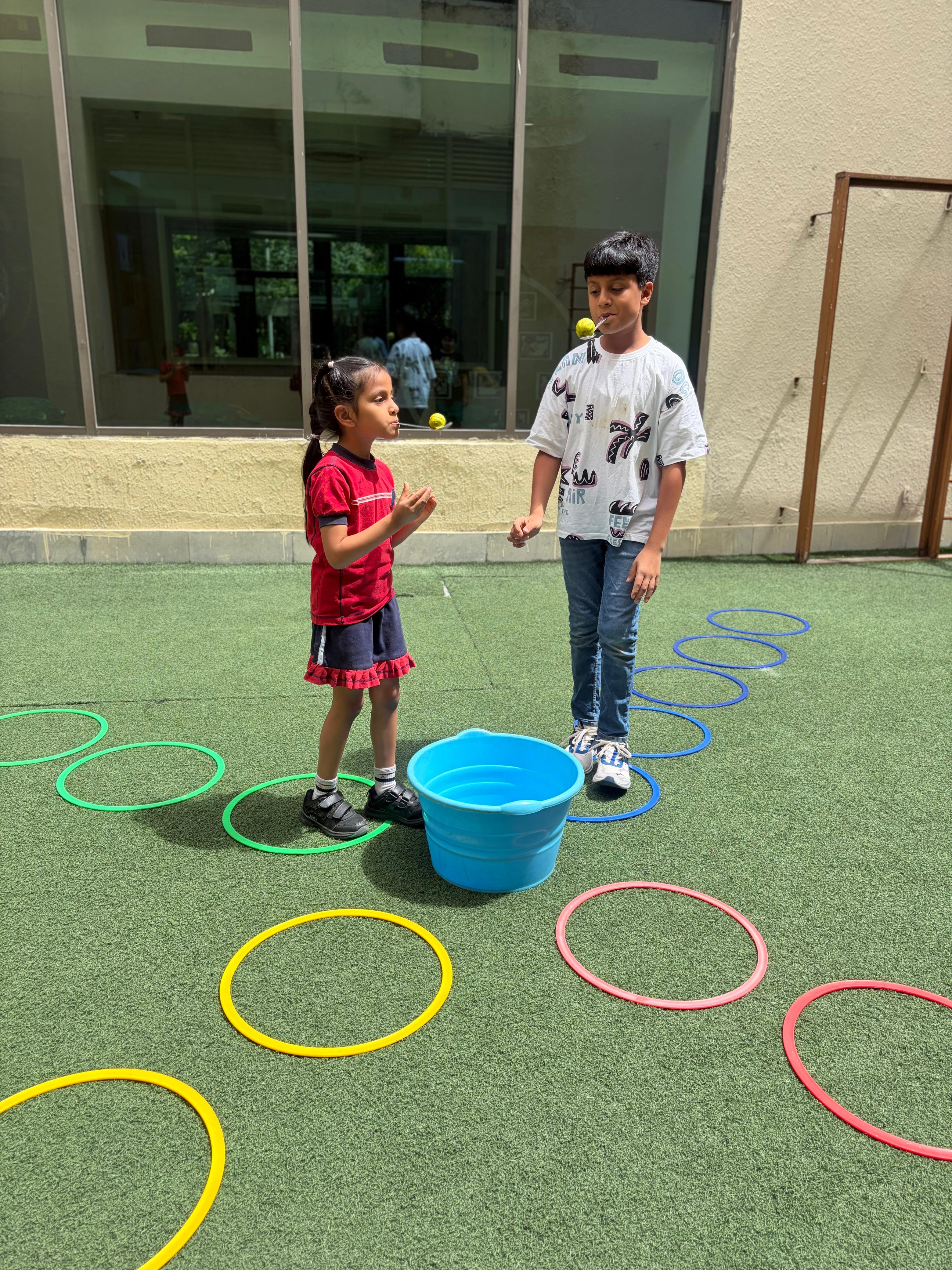
Red · Foundation Montessori
Foundation Montessori Red caters to children from two years. The children are independent and engage in various activities that refine their fine and gross motor movement, and the prepared environment helps them develop confidence and a love for learning. This is the age of "I can do it myself", and the Red room is prepared so that the answer can be yes: dressing frames, pouring and spooning, care of self and care of the environment, and the first sensorial materials.
Language is everywhere. Mentors name objects precisely, sing, read and tell stories, and the child's vocabulary grows in step with the hands. Grace and courtesy lessons begin here, with greeting, waiting, carrying a chair and offering help. [CONFIRM: maximum group size and mentor ratio; the earlier Noida site described a maximum of twelve children with one mentor]
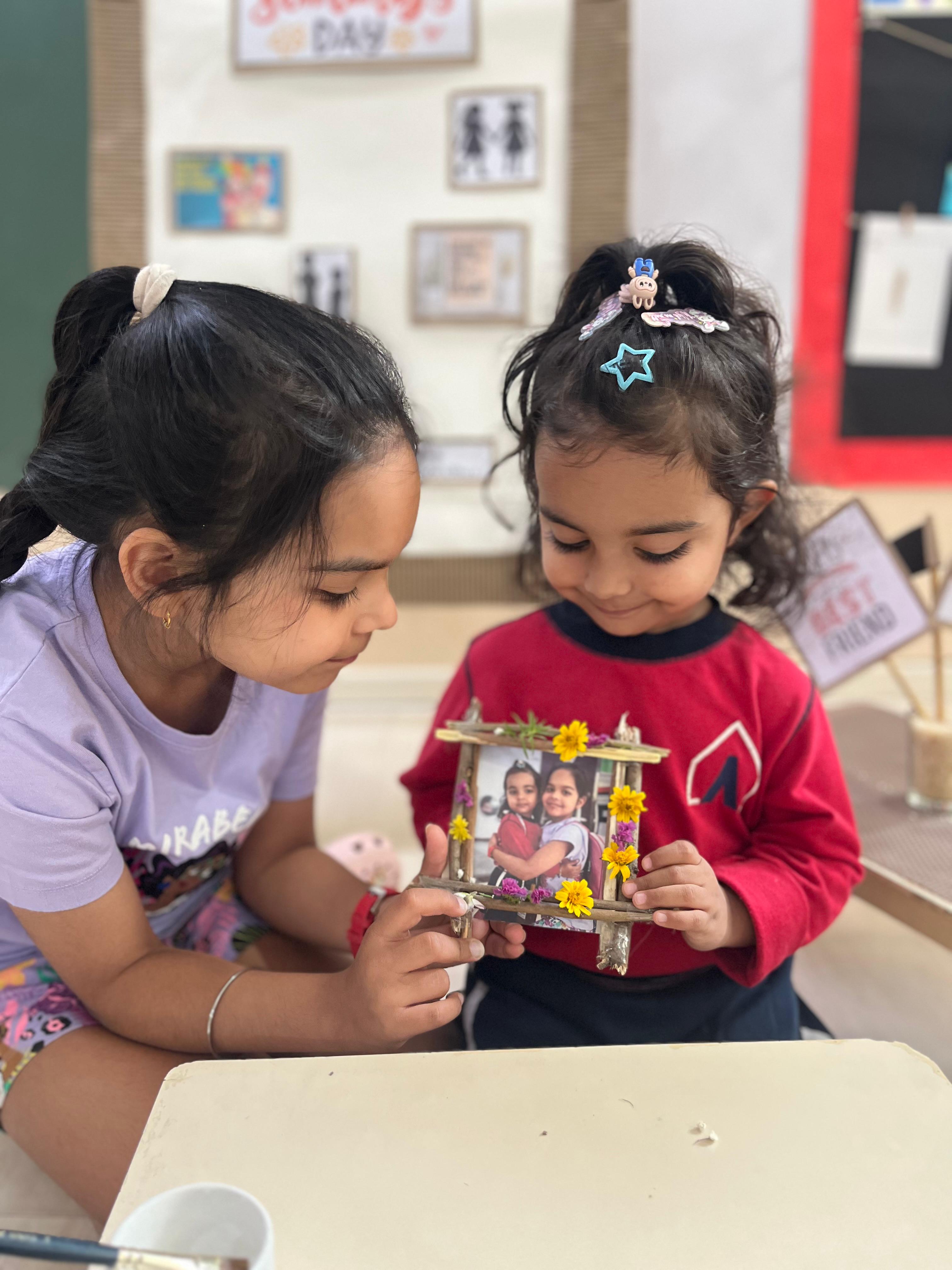
Blue · the Children's House
In the Blue environment the mission is to support each child's emerging intellect and nurture their human spirit. The House strives to foster self-discipline through the opportunity to exercise freedom appropriate to the child's developing sense of responsibility, and children are supported to develop strong character, perseverance, integrity and respect for others.
Blue is the mixed-age community that Dr. Montessori called the Children's House. Older children consolidate what they know by showing it to younger ones; younger children see what they will soon be able to do. The full range of apparatus is present, from practical life and sensorial through language, mathematics and the cultural subjects, and the work cycle is long enough for a child to complete a piece of work from choice to return.
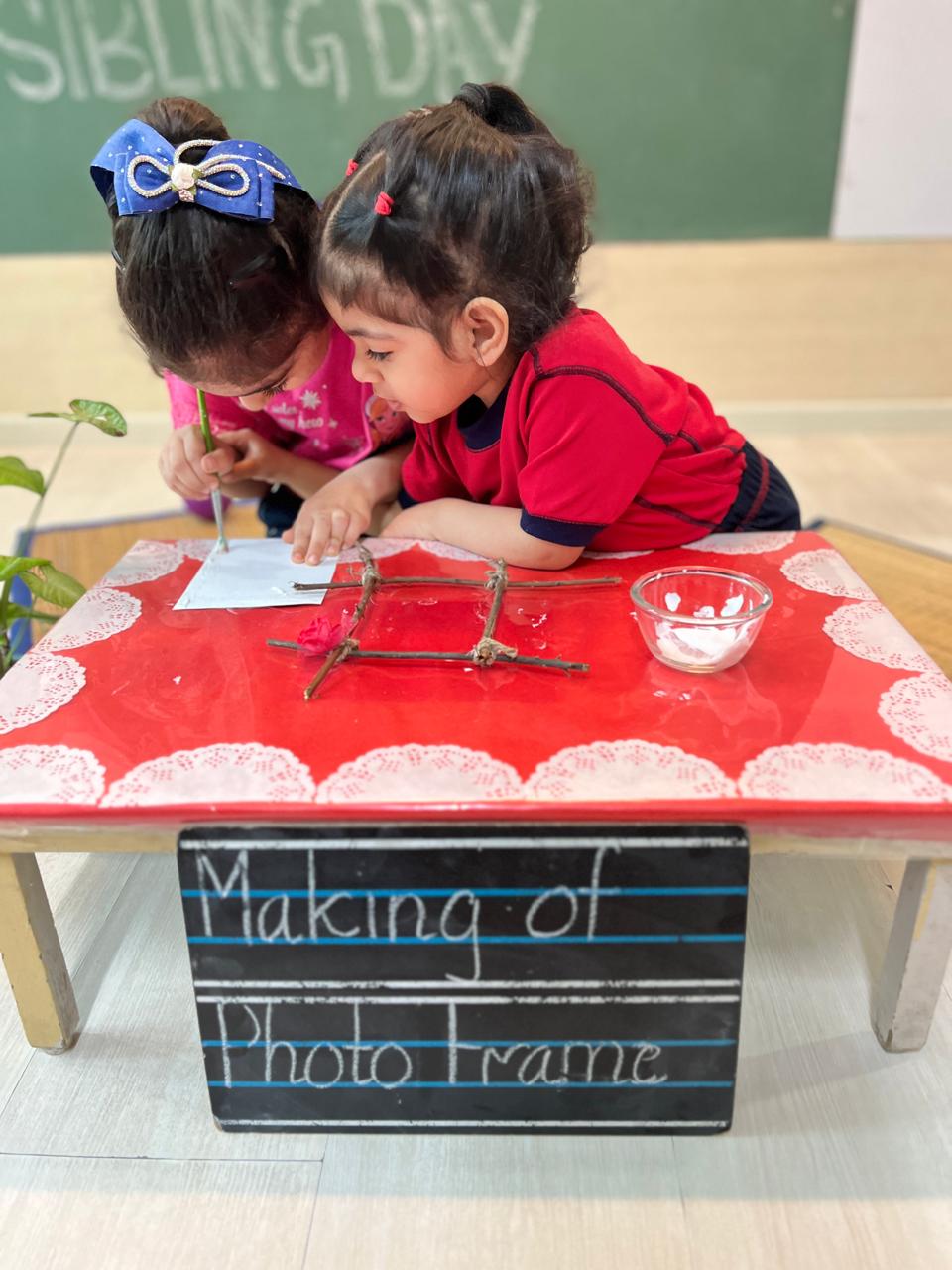
Yellow · Early Years Foundation Stage
In the final year of the House, the child's Montessori work is mapped to the Early Years Foundation Stage (EYFS): three prime areas of learning, in communication and language, physical development, and personal, social and emotional development, and four specific areas, in literacy, mathematics, understanding the world, and expressive arts and design. The materials and the mentor's role do not change; the framework gives families and the primary school a shared account of what the child has achieved.
This is the bridge to Cambridge Primary at The Ardee School, the feeder pathway from the Houses. Children leave EYFS having worked with letters, words and number in the concrete, and, above all, able to choose, begin, complete and put away a piece of work without being asked.
EYFS · Early Years Foundation Stage
In the final year of the House, the child's Montessori work is mapped to the Early Years Foundation Stage (EYFS): three prime areas of learning, in communication and language, physical development, and personal, social and emotional development, and four specific areas, in literacy, mathematics, understanding the world, and expressive arts and design. The materials and the mentor's role do not change; the framework gives families and the primary school a shared account of what the child has achieved.
This is the bridge to Cambridge Primary at The Ardee School, the feeder pathway from the Houses. Children leave EYFS having worked with letters, words and number in the concrete, and, above all, able to choose, begin, complete and put away a piece of work without being asked.
Choose the environment, then visit it.
Every enquiry begins with a tour of the House, virtually or in person.